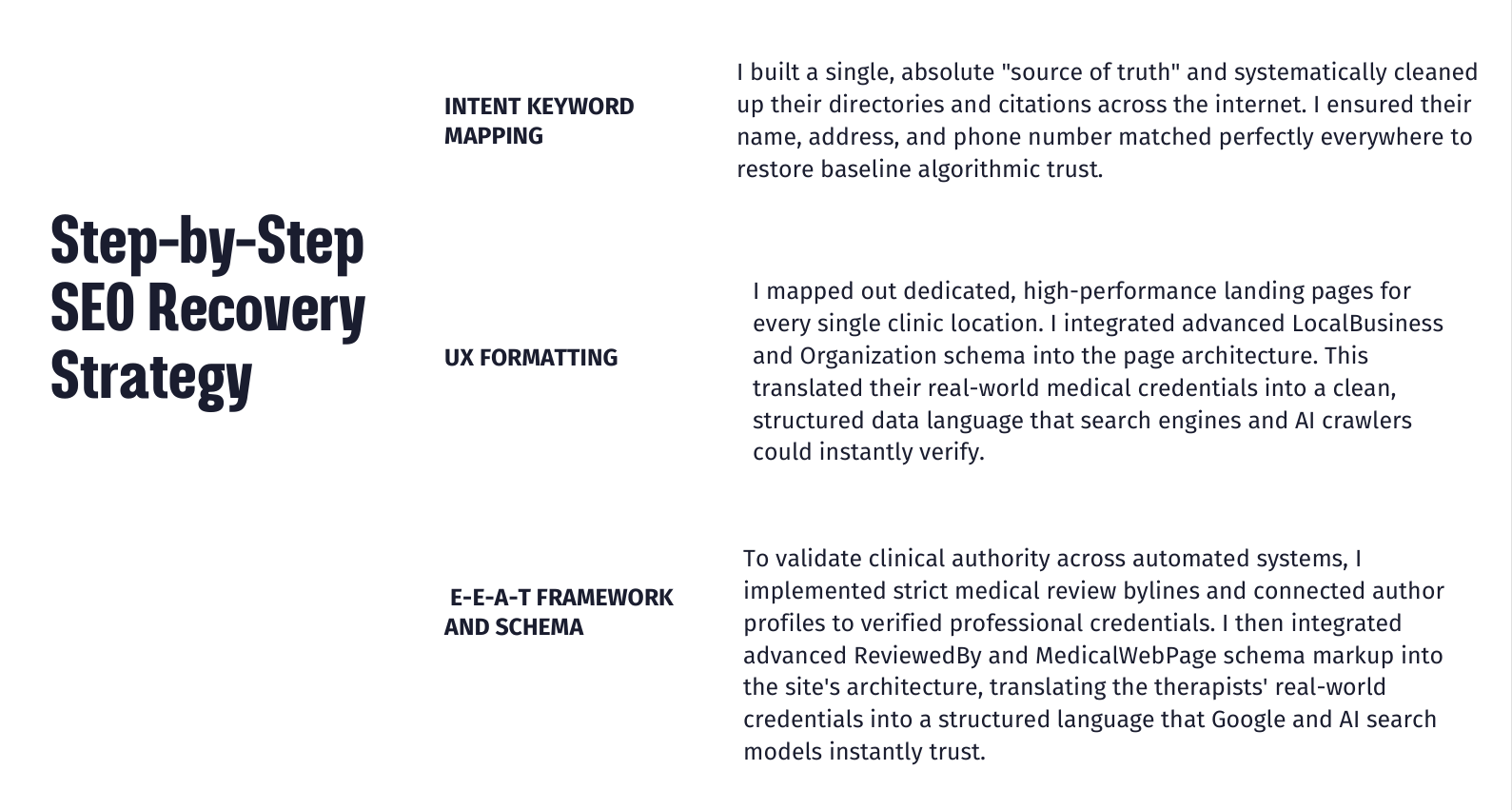
Everbe Web Application
HIGH-QUALITY CLINICAL CONTENT LEFT COMPLETELY INVISIBLE

Everbe a specialized psychology practice was publishing deeply insightful, clinical articles written by its therapists, yet the website’s organic growth was entirely stagnant. They were completely invisible for the specific, high-intent phrases people search for during moments of emotional distress. Traffic was minimal, and the few users who did land on the site left within seconds without booking an intake session. The practice was failing to bridge the gap between their clinical expertise and the complex digital journey of a vulnerable user. Realizing their message wasn't reaching the people who needed it most, they brought me in to align their digital presence with human behavior.
Diagnosis
The Academic Language Barrier:
The practice was optimizing content for dense, textbook terms (e.g., "Somatic Manifestations of Generalized Anxiety Disorder"). My behavioral data showed that real people experiencing distress search using emotional, conversational, first person language (e.g., "Why does my chest feel tight when I wake up?"). They were optimizing for peers, not patients.
The Algorithmic E-E-A-T Deficit
The articles lacked proper medical review markers, credentialed author transparency, and structured digital data. Search engine algorithms and AI crawlers downgraded the site's authority because they could not algorithmically verify the clinical trustworthiness (experience, expertise, authoritativeness, and trustworthiness) of the content creators.
Cognitive Overload in the UX
The page layouts consisted of long, unbroken walls of text. To an anxious, overwhelmed, or hyper aroused reader, this dense presentation created immediate cognitive friction, causing them to close the tab out of frustration and exhaustion.
SEO RESULTS
Aligning the content with natural human language and search behavior caused keyword rankings for high-intent mental health terms to skyrocket within 60 days.
Formatting the interface for cognitive ease stopped users from bouncing. Readers felt safe, understood, and regulated enough to stay and engage deeply with the material.
By placing supportive, low-friction prompts at the exact moment the reader felt validation for their experience, blog readers smoothly transitioned into registered clients.